Homeopathic Climatology

Abstract
The IPCC and most leading figures in the climate biz claim that "cumulative emissions," rather than the amount of CO2 in the atmosphere, determines CO2's warming effect.
Much of the CO2 emitted into the air by human industry has already been removed by natural processes. But "cumulative emissions" means the total of all anthropogenic CO2 emissions since the start of the industrial revolution, not the amount of CO2 accumulated (remaining) in the air. It is defined to be the arithmetic sum of all anthropogenic CO2 emissions to date. (References: AR6 Glossary, AR6 Technical Summary, and NetZeroClimate.org.)
In other words, they say that CO2 has just as much warming effect after it has been removed from the atmosphere as it had when it was still in the air. That is obviously nonsense.
Contents
1. Introduction
Mankind is adding CO2 to the atmosphere (mostly from fossil fuels), at a rate of about +5 ppmv/year. That rate has been generally accelerating since at least the 1940s (but ultimately it will be limited by finite fossil fuel supplies).
"Nature" (by which we mean the net sum of all non-anthropogenic CO2 fluxes) is currently removing CO2 from the atmosphere, but currently not as quickly as mankind is adding it. Anthropogenic CO2 emissions currently exceed natural CO2 removals by about 2.6 ppmv/year. That's why the CO2 level is rising by about 2.6 ppmv/year.
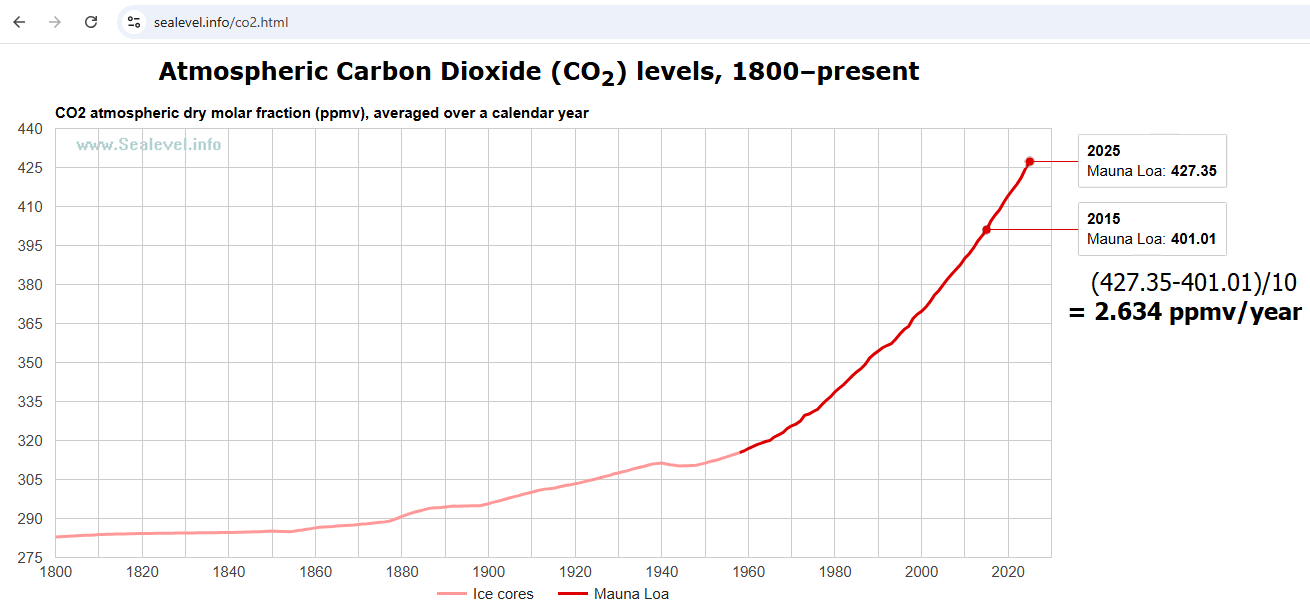
The rate at which nature removes CO2 from the atmosphere (moving it into the oceans, biosphere, soils, etc.) is mainly determined by the atmospheric CO2 level. That rate accelerates by about one ppmv/year for every 50 ppmv rise in the atmospheric CO2 level.
So if human CO2 emissions were to continue at the current rate indefinitely, the atmospheric CO2 level could only rise by about another 50 × 2.6 = 130 ppmv before plateauing, because at that level our emission rate would be equaled by the increased rate of natural CO2 removal.
The TCRE (Transient Climate Response to cumulative carbon Emissions) / RCB (Remaining Carbon Budget) concept is based on the assumption that those removals don't matter, and that temperatures will continue to rise even if CO2 levels are no longer rising, or even if CO2 levels are falling, as long as anthropogenic CO2 emissions are not zero. It assumes that emissions alone determine the warming effect.
In other words, it assumes the mere memory of CO2 formerly in the air has as much warming effect as the CO2 which remains.
That assumption is essential to justify the "Net Zero" campaign.
It's also very similar to the "water memory" concept which is the basis of homeopathic medicine.
2. Discussion
2.1. Carbon cycle feedbacks
Climate industry sources dwell on (and often exaggerate)
positive (amplifying)
climate feedbacks, and ignore most
negative (stabilizing/
Carbon feedbacks are overwhelmingly negative (stabilizing). When CO2 levels are rising (as they are now), negative carbon feedbacks are the "carbon sinks" which remove CO2 from the air at an accelerating pace.
The two most important carbon feedbacks are marine uptake and terrestrial "greening" & soil enrichment. They both accelerate approximately linearly as the CO2 level in the atmosphere rises, meaning that the higher the CO2 level rises, the faster those natural "carbon sinks" remove CO2 from the atmosphere:
-
CO2 Absorption by water feedback:
higher CO2 level
→ faster absorption of CO2 from atmosphere by oceans
→ lower CO2 level -
CO2 Fertilization Feedback (“greening”):
higher CO2 level
→ accelerated plant growth
→ faster removal of CO2 from the air
→ lower CO2 level
Negative temperature feedbacks help stabilize the Earth's temperatures, and negative carbon feedbacks help stabilize the atmospheric CO2 level. Both matter.
W/r/t absorption of CO2 by water, the linearity is probably intuitively obvious: the more CO2 molecules there are in the air, the more frequent are their collisions with liquid water. It's actually more complicated than that, because of chemical and biological processes, but it's nevertheless approximately linear. The CO2 level in ocean surface water closely tracks the atmospheric CO2 level, and that in turn determines the rate at which carbon is carried into the ocean depths by thermohaline circulation and "marine snow."
Carbon uptake by the terrestrial biosphere is less obviously linear, but we know from agronomy studies that "CO2 fertilization" enhances C3 plant growth nearly linearly to above 1000 ppmv. The plants which sequester the most carbon (trees, sphagnum moss) are C3 plants, so that carbon feedback, too, should be approximately linear:
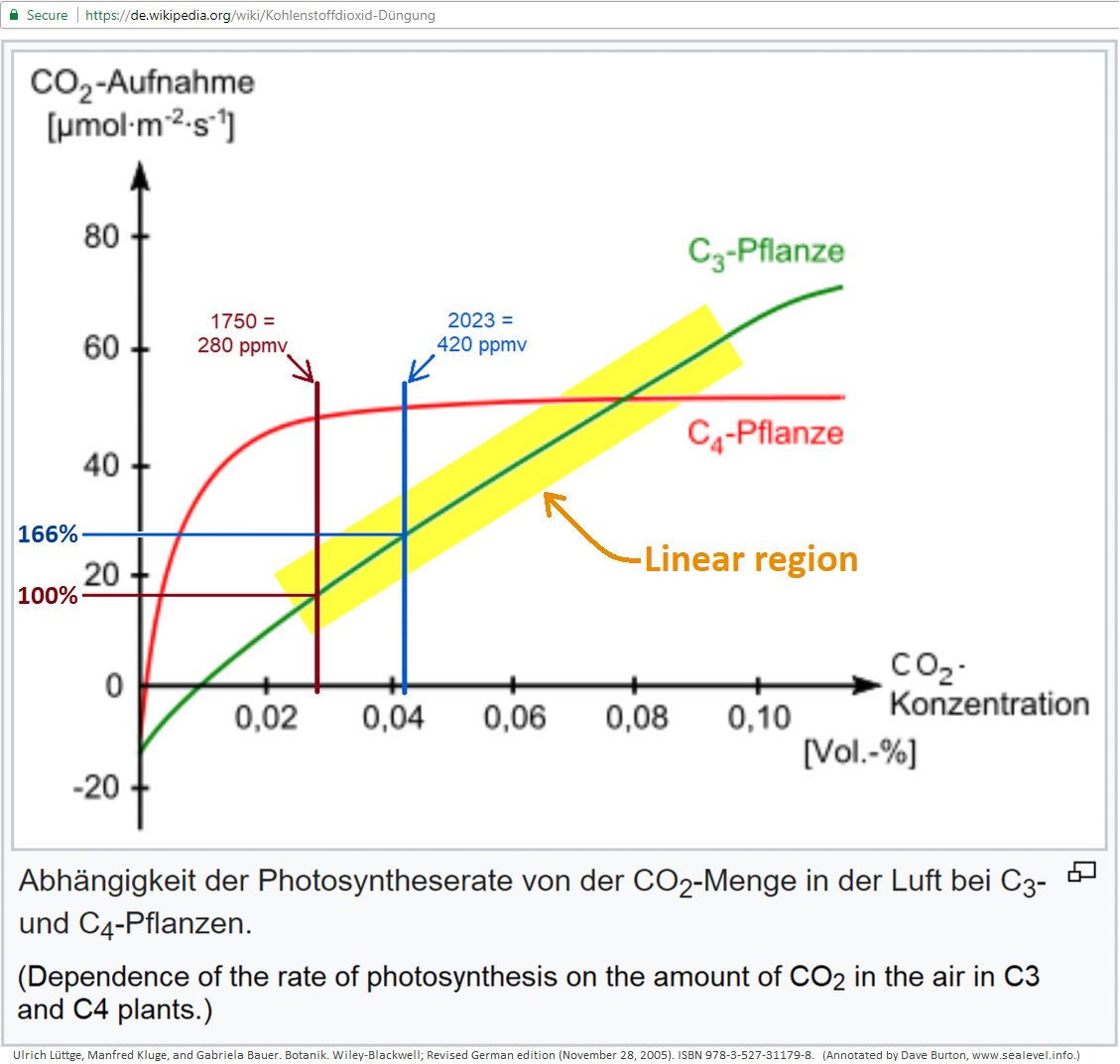
(click to enlarge)
https://sealevel.info/Eldarica_pine_trees_vs_CO2_with_line.png
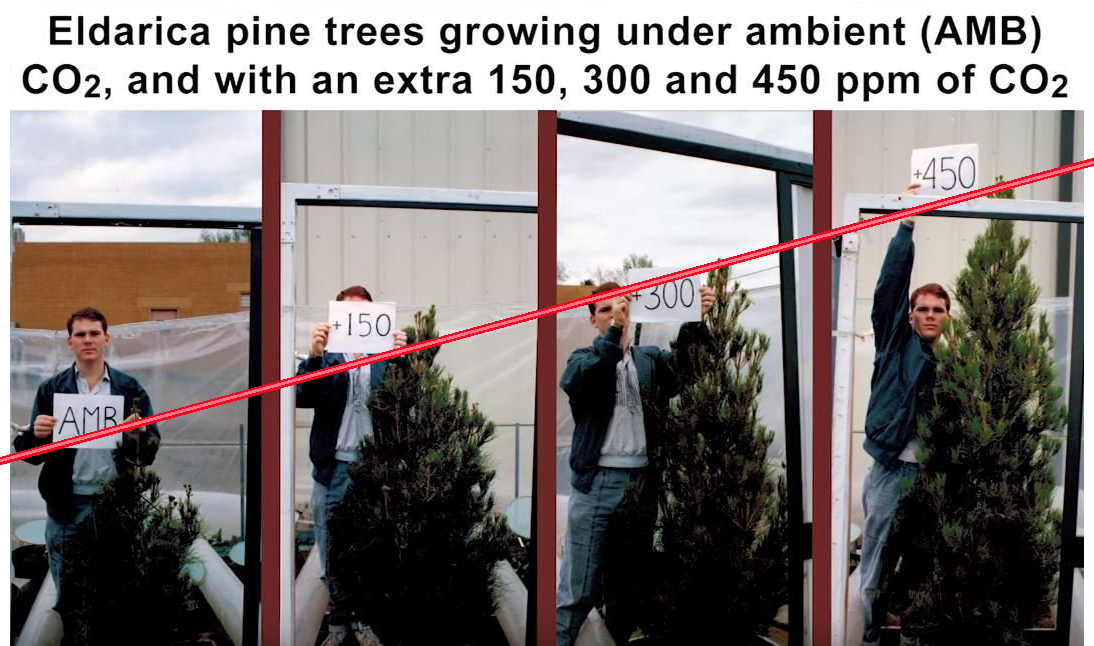
(click to enlarge)
It's mainly the CO2 level in the atmosphere which determines the net natural CO2 removal rate. There are other things that affect it, like water temperatures, but those are minor:
"From what we understand about the underlying processes, uptake of atmospheric CO2 should react not to a change in emissions, but to a change in concentrations." (Knorr, 2009)
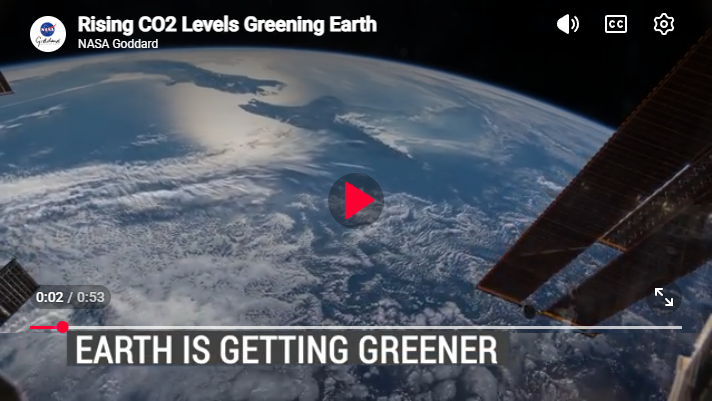
The rate at which the terrestrial biosphere removes CO2 from the atmosphere has been accelerating as the Earth "greens" and plant growth accelerates. In fact, the greening trend is so dramatic that NASA satellites can measure it from space:
The sum of any two linear functions is also linear, so the net rate of natural CO2 removals from the atmosphere must also be an approximately linear function of the CO2 level in the atmosphere.
That's confirmed by the data. The linearity is obvious if you plot the net CO2 removal rate (calculated as the difference between anthropogenic emissions and the observed year-over-year change in CO2 level) vs. the atmospheric CO2 level, as in this graph:
https://sealevel.info/Global_Carbon_Budget_2023v1.1_with_removal_rate_plot4.png
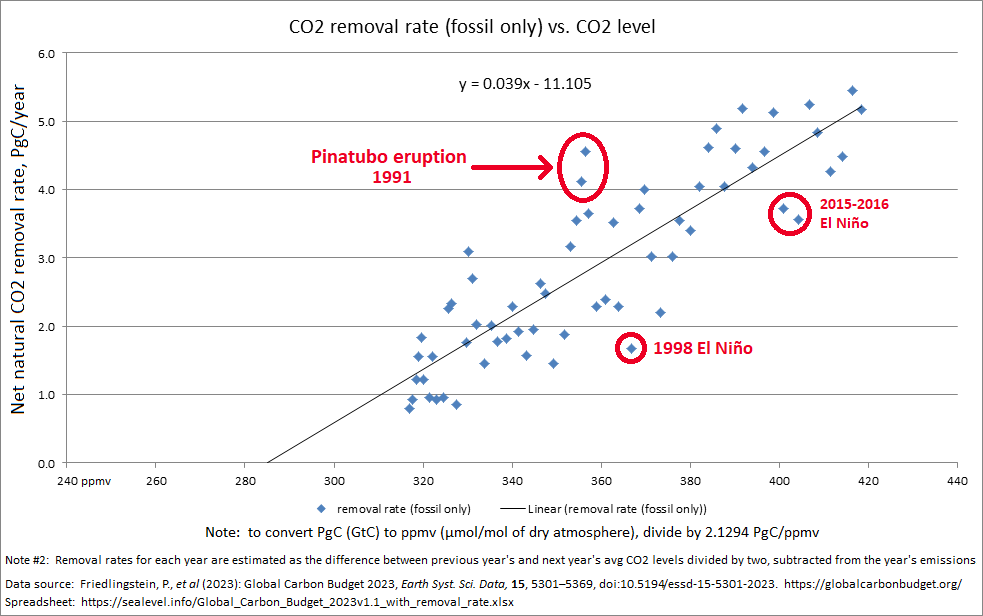
(Adapted from "Fig. 1" here; here's the spreadsheet.)
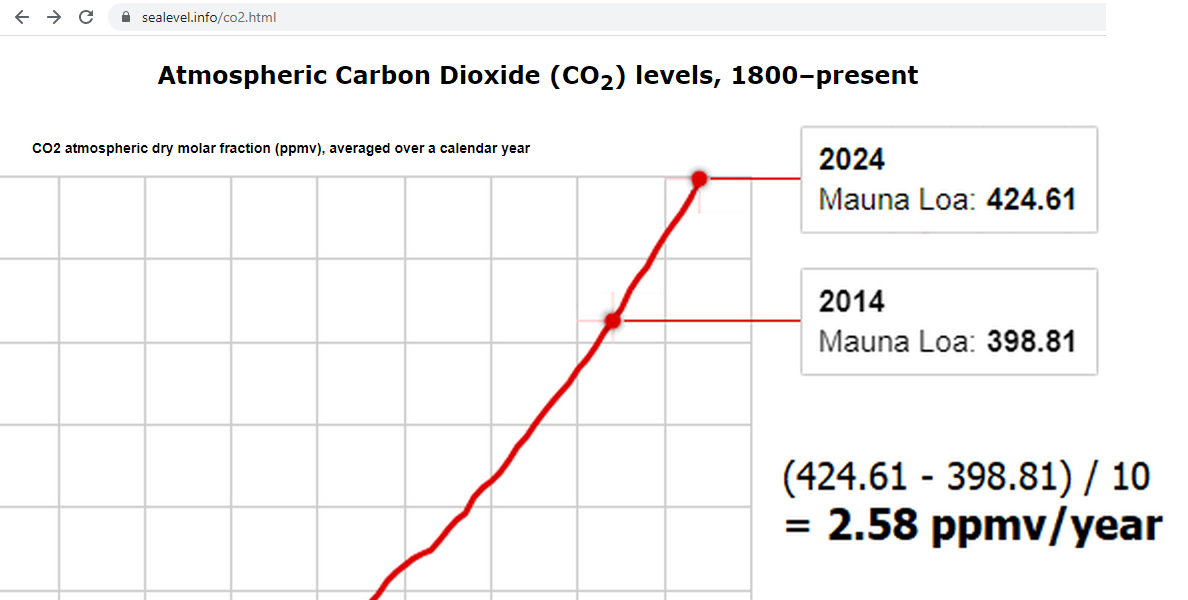
Mankind is currently adding >5 ppmv of CO2 to the atmosphere every year. The best estimate, mostly from emission data, is that we're adding a total of about 5.2 ppmv (≅ 11 GtC ≅ 40 Gt CO2) per year, roughly 90% of it from fossil fuels. But, thanks to negative carbon feedbacks (natural carbon sinks), the CO2 growth rate in the atmosphere is only about half that rate: about 2½ ppmv/year.
The "climate science community" acknowledges the uptake of CO2 by the oceans and terrestrial biosphere. E.g., this is from the 2025 GCP report (except that I added the pink annotations):
https://sealevel.info/GCP2025_overview_annot3.png
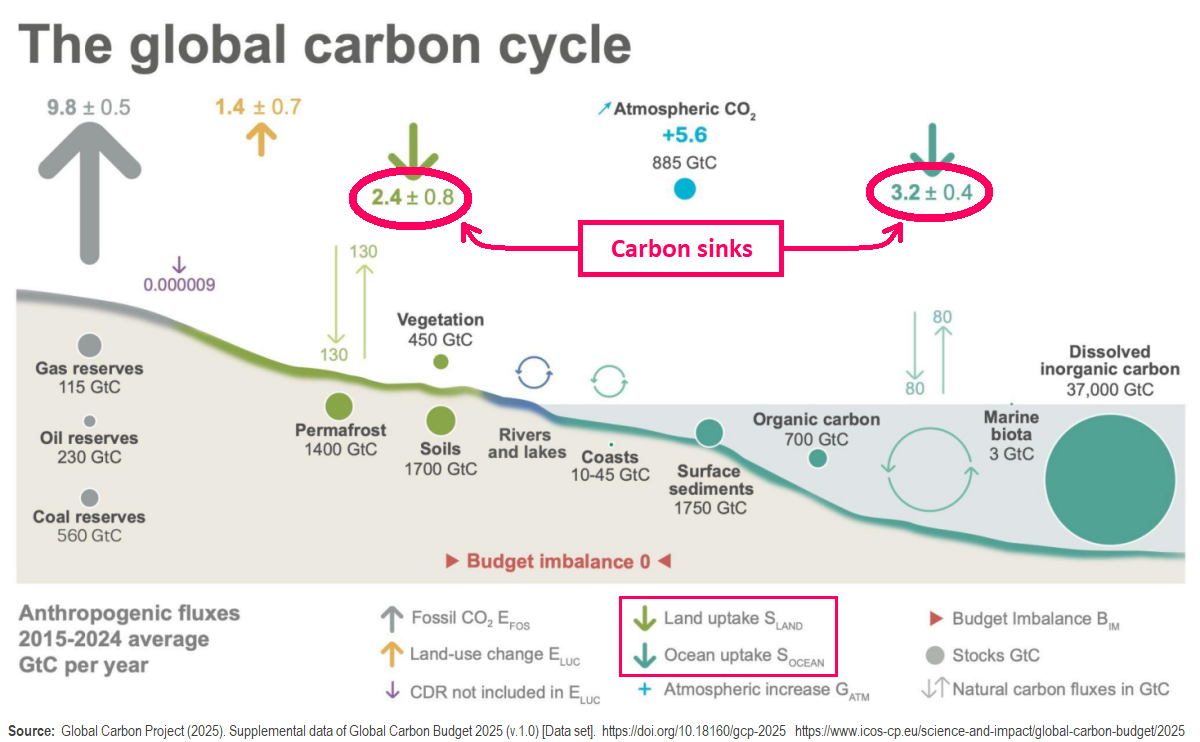
(click to enlarge)
This is an excerpt from Table 5.1 in the AR6 WG1 report (I added the red annotation):
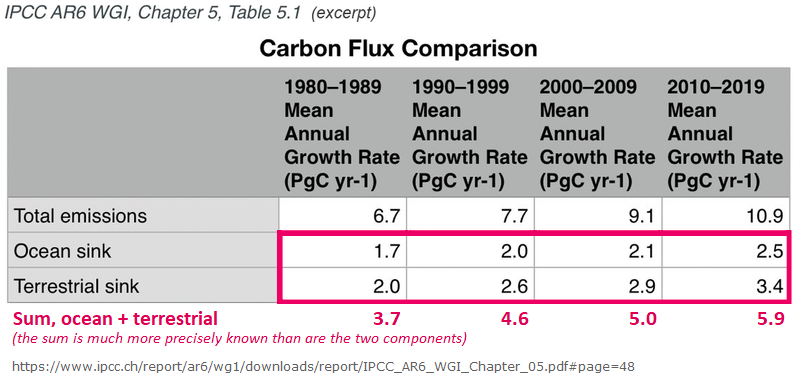
Note how the estimated rate at which the oceans and terrestrial biosphere are removing CO2 from the air is accelerating as the CO2 level rises: 3.7 PgC/yr in the 1980s → 4.6 → 5.0 → 5.9 PgC/yr in the 2010s.
That's an acceleration in CO2 removal rate of 2.2 PgC/year in 30 years. Converting from PgC to ppmv (divide by 2.1294 PgC/ppmv) yields an acceleration in removal rate by just over 1.0 ppmv/year, as the CO2 level rose from 346 ppmv in 1985 to 401 ppmv in 2015. That corresponds to a CO2 removal rate acceleration of 0.945 ppmv/year per 50 ppmv rise in CO2 level, implying an adjustment time of 53 years.
2.2. Homeopathic climatology is required to justify Net Zero
If you're interested in the impact of carbon emissions, you obviously must not ignore the accelerating removal of CO2 from the atmosphere by natural carbon sinks! But that's exactly what the IPCC does to justify the "Net Zero" campaign.
In fact, AR6 explicitly posits that the removal of CO2 from the air by natural processes does not matter, because, they say, the effect of CO2 on temperature is determined by total emissions to date ("cumulative emissions"), which means it is unaffected by natural removals of CO2 from the air.
Note that "cumulative CO2 emissions" is not the amount of CO2 accumulated (remaining) in the atmosphere. It is defined to be the arithmetic sum of all anthropogenic CO2 emissions to date. Refs: AR6 Glossary, AR6 Technical Summary, and NetZeroClimate.org (Oxford U.):
"Global warming is proportional to cumulative CO2 emissions, which means that the planet will keep heating for as long as global emissions remain more than zero." (NetZeroClimate.org)
That's so obviously wrong that it sounds like a joke, doesn't it? But I'm not kidding.
They call it "transient climate response to cumulative CO2 emissions" (TCRE) and "remaining carbon budget" (RCB). It is an essential assumption to justify the Net Zero campaign:
"The transient climate response to cumulative CO2 emissions (TCRE) is a metric of climate change that directly relates the primary cause of climate change (cumulative CO2 emissions) to global mean temperature change." (MacDougall 2016)
Here's the AR6 version (from AR6 WG1 TS.3.2.1; see also §5.5, §1.6.3, and SYN 3.3.1):
https://sealevel.info/AR6_WG1_TS3.2.1_TCRE_definition5_high_confidence.png
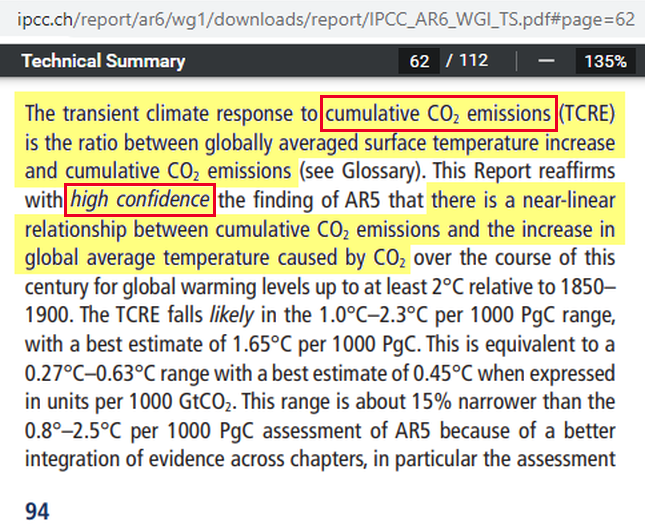
Source: AR6 WG1 TS.3.2.1 (p.94)
Notice their "high confidence" that CO2 has just as much warming effect after it's been removed from the atmosphere by natural sinks as it had while it remained, which is obviously impossible.
https://sealevel.info/AR6_WG1_BoxTS.1_RCB_definition3.png (click to enlarge)
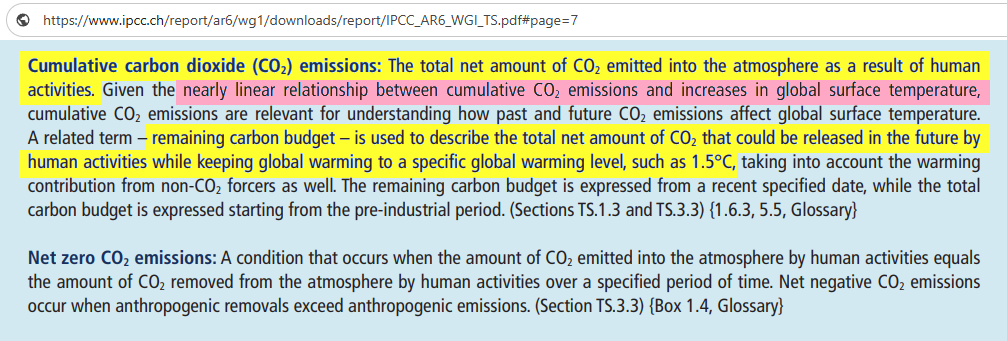
Source: AR6 WG1 Box TS.1 (p.39)
2.3 Adjustment time
The higher the CO2 level in the atmosphere goes, the faster nature removes CO2 from the atmosphere. Quantitatively, for each fifty ppmv rise in the CO2 concentration, the rate of natural CO2 removals accelerates by about 1 ppmv/year. That makes the effective lifetime of CO2 added to the air (the "adjustment time") about 50 years, and the half-life of added CO2 is about 50 × ln(2) ≌ 35 years.
That inconvenient fact was mentioned in the IPCC SAR (1995), but it has been omitted from subsequent IPCC Reports. The SAR (WGI TS, B.1, p.16) said:
"Within 30 years about 40-60% of the CO2 currently released to the atmosphere is removed."
That implies a half-life of
23 to
41
years, and an adjustment time of
Roughly the same result has also been reported by many other researchers, including:
-
Berrien Moore III and B. H. Braswell (1994). "The lifetime of excess atmospheric carbon dioxide."
Global Biogeochem Cycles, 8(1), 23–38.
https://doi.org/10.1029/93GB03392
Excerpt: "The single half-life concept focuses upon the early decline of CO2 under a cutoff/decay scenario. If one assumes a terrestrial biosphere with a fertilization flux, then our best estimate is that the single half-life for excess CO2 lies within the range of 19 to 49 years, with a reasonable average being 31 years." [A half-life of 19-49 years = an adjustment time of 27 to 71 years] -
Tahvonen, O., et al. (1994). "Economic efficiency of CO2 reduction programs." Climate Research, 4, 127–141. https://doi.org/10.3354/cr004127
Excerpt: "For the emission, E(t), we use the data from Marland (1989) for the same time interval. This gives σ = 0.018 yr⁻¹, indicating a memory of 55 yr for the concentration." -
Dietze, P. (2001). "Carbon Model Calculations." Retrieved from
http://www.john-daly.com/dietze/cmodcalc.htm -
Engelbeen, Ferdinand (2022). "The origin of the increase of CO2 in the atmosphere."
http://www.ferdinand-engelbeen.be/klimaat/co2_origin.html (section 3) -
Spencer, Roy W. (2023). "ENSO Impact on the Declining CO2 Sink Rate."
J Mari Scie Res Ocean, 6(4), 163–170.
https://doi.org/10.33140/jmsro.06.04.03 - Engelbeen F. et al. (2024). "The Human Contribution to Atmospheric Carbon Dioxide." CO2 Coalition. https://doi.org/10.31219/osf.io/het6n
- Happer, W. et al. (2026). "Human Emissions and Atmospheric Concentrations of Carbon Dioxide." CO2 Coalition.
2.4. TCRE, RCB and “2 memory”
In the real world, CO2 removed from the atmosphere no longer has a warming effect. But TCRE / RCB ignores the removal of CO2, and considers only additions of CO2 to the air. In other words, it is predicated on the assumption that the mere memory of CO2 once in the atmosphere has just as much warming effect as the CO2 which remains.
That assumption is essential to justify the Net Zero campaign—and it's as nonsensical as orgone energy and quantum healing crystals. It is basically homeopathic climatology.
Homeopathic medicine is based on "water memory," the claim that even after a medicine is diluted so much that not a single molecule of the original therapeutic agent remains, its medicinal effect is undiminished, or even increased.
Similarly, homeopathic climatology is based on "CO2 memory," the assumption that CO2 has just as much warming effect after it is removed as it had while still in the air.
How can anyone take seriously an institution like the IPCC which promotes such crackpottery?
Here are some homeopathic climatology (TCRE / "cumulative carbon emissions" and RCB / "remaining carbon budget") papers:
-
Allen, M., Frame, D., Huntingford, C. et al. (2009).
"Warming caused by cumulative carbon emissions towards the trillionth tonne."
Nature 458, 1163–1166.
https://doi.org/10.1038/nature08019 -
Matthews, H.D., Gillett, N., Stott, P. et al. (2009).
"The proportionality of global warming to cumulative carbon emissions."
Nature 459, 829–832.
https://doi.org/10.1038/nature08047 -
Gillett, N., Arora, V., Matthews, D. and Allen, M. (2013).
"Constraining the Ratio of Global Warming to Cumulative CO2 Emissions Using CMIP5 Simulations."
J Climate 26(18), 6844–6858.
https://doi.org/10.1175/JCLI-D-12-00476.1 -
Andrew H. MacDougall and Pierre Friedlingstein (2015).
"The Origin and Limits of the Near Proportionality between Climate Warming and Cumulative CO2 Emissions."
J Climate 28(10), 4217–4230.
https://doi.org/10.1175/JCLI-D-14-00036.1 -
MacDougall, Andrew H. (2016). "The Transient Response to Cumulative CO2 Emissions: a Review."
Curr Clim Change Rep 2, 39–47
https://doi.org/10.1007/s40641-015-0030-6 -
Zickfeld, K., MacDougall, A. H., and Matthews, H. D. (2016).
"On the proportionality between global temperature change andcumulative CO2 emissions during periods of net negative CO2 emissions."
Environ. Res. Lett. 11 (2016) 055006.
https://doi.org/10.1088/1748-9326/11/5/055006 -
MacDougall, Andrew H. (2017). "The Uncertainty in the Transient Climate Response to
Cumulative CO2 Emissions Arising from the Uncertainty in Physical Climate Parameters."
J Climate 39(2), 813–827.
https://doi.org/10.1175/JCLI-D-16-0205.1 -
Matthews, H.D. et al. (2018).
"Focus on cumulative emissions, global carbon budgets and the implications for climate
mitigation targets."
Environ. Res. Lett. 13(1) 010201.
https://doi.org/10.1088/1748-9326/aa98c9 -
Rogelj, J., Forster, P.M., Kriegler, E. et al. (2019).
"Estimating and tracking the remaining carbon budget for stringent climate targets."
Nature 571, 335–342.
https://doi.org/10.1038/s41586-019-1368-z -
Lahn, G. (2020). "A history of the global carbon budget."
WIREs Clim Change 2020; 11:e636.
https://doi.org/10.1002/wcc.636 -
Jenkins, S., Cain, M., Friedlingstein, P. et al. (2021).
"Quantifying non-CO2 contributions to remaining carbon budgets."
npj Clim Atmos Sci 4, 47.
https://doi.org/10.1038/s41612-021-00203-9 -
Matthews, H.D., Tokarska, K.B., Rogelj, J. et al. (2021).
"An integrated approach to quantifying uncertainties in the remaining carbon budget."
Commun Earth Environ 2, 7.
https://doi.org/10.1038/s43247-020-00064-9 -
Lamboll, R.D., Nicholls, Z.R.J., Smith, C.J. et al. (2023).
"Assessing the size and uncertainty of remaining carbon budgets."
Nat. Clim. Chang. 13, 1360–1367.
https://doi.org/10.1038/s41558-023-01848-5
2.5. The “Airborne Fraction” error
AR6 WG1 Chapter 7 attempts to defend TCRE by appeal to the "airborne fraction" fallacy. They say:
"TCRE combines information on the airborne fraction of cumulative CO2 emissions (the fraction of the total CO2 emitted that remains in the atmosphere at the time of doubling, which is determined by carbon cycle processes) with information on the TCR." (AR6, WG1, Chapter 7, Box 7.1)
But the "airborne fraction" is not fixed. In fact, it doesn't represent anything physical. It's just the calculated ratio of the observed rate of CO2 increase in the atmosphere and the anthropogenic CO2 emission rate.
To justify TCRE, AR6 WG1 Box 7.1 assumes that the airborne fraction is fixed. But that is inconsistent with the physical processes which remove CO2 from the air:
"From what we understand about the underlying processes, uptake of atmospheric CO2 should react not to a change in emissions, but to a change in concentrations." (Knorr 2009)
Changes in the anthropogenic emission rate do not cause proportional changes in natural CO2 removal rates. In fact, if human emissions were reduced by more than the rate at which the CO2 level is rising (currently about +2.6 ppmv/year), that would cause the level in the atmosphere to begin falling, and the "airborne fraction" would be negative.
In that scenario, the CO2 level in the atmosphere would be falling despite "cumulative emissions" continuing to increase. The radiative forcing from CO2 would be decreasing, and the Earth would presumably be cooling (unless some other factor exceeded CO2's effect). But, according to the IPCC's homeopathic climatology, temperatures would continue to rise.
2.6. Where are the papers objecting to this nonsense?
I tried to get ChatGPT to find papers which reject TCRE / RCB, without much success:
My guess is that some authors have probably tried to publish such papers, but activist "gatekeepers" at the major journals have rejected them. But that's just a guess.
3. Conclusion
Despite being broadly accepted in the climate community, the "cumulative emissions" framework is pseudoscientific nonsense. It is based on the assumption that CO2 has just as much warming effect after it has been removed from the atmosphere as it had when it was still in the air. That is obviously wrong.
It effectively applies the principles of homeopathic medicine to climatology, to justify the Net Zero campaign.
David A. Burton
2026
SeaLevel.info
First version: 19-May-2026
Last modified: 31-Aug-2026 (version 31)
Note: the “last modified” date and version number on this web page are
maintained automatically by TLIB Version Control.